17 Best Winter Jackets in 2026: Tested Picks for Real Cold
Buying a winter jacket sounds simple—until you realize how many ways winter can go wrong. Dry cold, wet snow, strong wind, temperature swings, long commutes, travel, and layering all demand different things from a jacket. What feels perfect in January can be miserable by March, and the warmest option isn't always the one you'll wear most.
We narrowed this list by comparing how jackets perform in real use—how warm they feel over a full day, how well they handle wind and wet snow, how comfortable they are to move in, and whether the design details hold up to regular wear. The jackets that stood out for a specific scenario made the cut.
That's why this guide doesn't rank jackets from "best to worst." Instead, it groups 17 winter jackets by real-world use cases, from one-jacket solutions and unpredictable winters to extreme cold, lightweight layering, value picks, and everyday city wear.
Quick Picks of the Best Winter Jackets for Men
Best Overall Winter Jackets
- Alpargali Aerogel Graphene Puffer Jacket
- Patagonia Jackson Glacier
- The North Face McMurdo Parka
Best for Wet, Windy & Unpredictable Winters
- REI Co-op Stormhenge Down Hybrid
- Arc'teryx Ralle Down Parka
Best Performance Jackets for Extreme Cold
- Alpargali Puffer Pro
- Fjällräven Expedition Down Parka
- Patagonia Stormshadow Parka
Best Lightweight Warmth & Layering Jackets
- Alpargali Graphene Lightweight Jacket
- Rab Neutrino Pro
- Patagonia Nano Puff
- Alpargali CoreShell Jacket
Best Value Winter Jackets
- L.L.Bean Baxter State Parka
- Eddie Bauer Stadium Coat
Best Style-Forward Winter Picks
- Fjällräven Nuuk Parka
- Patagonia Downdrift
- Schott NYC Wool Peacoat

Alpargali Aerogel Graphene Puffer Jacket
Best Overall

Patagonia Jackson Glacier
Best Overall

The North Face McMurdo Parka
Best Overall

REI Co-op Stormhenge Down Hybrid
Wet & Windy

Arc'teryx Ralle Down Parka
Wet & Windy

Alpargali Puffer Pro
Extreme Cold

Fjällräven Expedition Down Parka
Extreme Cold

Patagonia Stormshadow Parka
Extreme Cold

Alpargali Graphene Lightweight Jacket
Lightweight

Rab Neutrino Pro
Lightweight

Patagonia Nano Puff
Lightweight

Alpargali CoreShell Jacket
Lightweight

L.L.Bean Baxter State Parka
Best Value

Eddie Bauer Stadium Coat
Best Value

Fjällräven Nuuk Parka
Style-Forward

Patagonia Downdrift
Style-Forward

Schott NYC Wool Peacoat
Style-Forward
Best Overall Winter Jackets
This category is for people who don't want to overthink winter dressing. The best overall winter jackets aren't extreme in one direction; they're reliable, adaptable, and easy to live with.
Alpargali Aerogel Graphene Puffer Jacket
Best for: If you want one dependable winter jacket that handles real cold, changing weather, and daily wear without feeling bulky or fragile, this is a strong pick.
| Comfort range | -40°C to +10°C |
| Shell | Teflon™ water- & stain-resistant fabric |
| Insulation | Multi-layer system (Aerogel + Graphene + Sorona®) |
| Breathability | 10,000 g/m² / 24h |
| Pockets | 9 functional pockets |
What stands out here is how stable the jacket feels across different situations. You don't need to baby it, and you don't need to constantly adjust what you're wearing underneath. It's warm enough for long, cold outdoor stretches, but it doesn't immediately overheat when you step inside or get on public transit.
The insulation setup isn't about chasing maximum loft—it's about even warmth and consistency. Heat doesn't dump out through the back or shoulders, and the jacket doesn't develop obvious cold spots when the wind picks up. That makes it feel dependable rather than impressive-for-five-minutes.
From a day-to-day standpoint, the design choices make sense. The pocket layout is practical (not decorative), the collar is comfortable against bare skin, and the shell handles light snow and winter drizzle without soaking through. It's the kind of jacket you grab without thinking, which is usually the highest compliment.
If your priority is pure simplicity, this may feel more technical than you want. The multiple pockets and performance details add usefulness, but they also mean it doesn't have the ultra-clean look of a fashion-first winter coat.
It's also not a niche specialist. If you only need something for deep sub-zero expeditions—or, on the other end, for mild winters just above freezing—there are more targeted options. This jacket is about versatility, not extremes.
Yes, if you want one winter jacket you can rely on for most situations: commuting, travel, walking, and everyday outdoor use in real winter conditions.
Pass if you're shopping for a purely minimalist city coat or a single-purpose extreme-cold parka—you'll be paying for flexibility you won't fully use.
Patagonia Jackson Glacier
Best for: A clean, everyday winter parka for people who want real warmth and weather protection—without looking like they're headed to base camp.
| Insulation | 700-fill recycled down |
| Shell | H2No® Performance Standard 2-layer waterproof fabric |
| Length | Mid-thigh coverage |
| Fit | Relaxed, easy to layer under |
The Jackson Glacier works because it's quietly competent. It doesn't try to be the warmest or the most technical jacket on the market—it just does winter well. The waterproof shell makes a noticeable difference in wet snow and slushy conditions, especially compared to traditional down parkas that rely only on a DWR finish.
It's also one of those jackets you actually want to wear every day. The silhouette is clean, the branding is subtle, and it doesn't feel out of place in an office, on a flight, or walking through a city in winter. Warmth is well balanced: enough for standing around in cold weather, but not so aggressive that you're overheating the moment you step indoors.
If you're often exposed to prolonged, deep cold—or you run cold in general—this may feel a bit restrained. It's warm, but it's not built for -30°C wind chills or long, stationary outdoor use. The length is practical, but not generous, and that limits how much heat it traps compared to heavier expedition-style parkas.
Yes, if your winter involves cold + wet weather and you want a jacket that fits seamlessly into daily life.
If your priority is maximum warmth above all else, or you spend long periods outside in extreme cold, you'll want something more purpose-built.
The North Face McMurdo Parka
Best for: A classic, protective winter parka for people who want straightforward warmth, coverage, and weather resistance.
| Insulation | 600-fill recycled down |
| Shell | Seam-sealed DryVent™ 2-layer waterproof fabric |
| Length | Long parka cut (around mid-thigh to knee) |
| Weight | On the heavier side for a down parka |
The McMurdo is unapologetically a big winter coat, and that's exactly why it works. The longer cut, insulated hood, and fully seam-sealed shell make it effective in wind, snow, and messy winter weather. You can stand around in the cold, walk into strong gusts, or deal with wet snowfall without feeling exposed.
This is also one of those jackets that feels reassuringly durable. It's not delicate, it doesn't require special care, and it holds up well to daily wear—whether that's commuting, walking the dog, or dealing with rough winter conditions.
You pay for that protection in weight and bulk. It's not something you want to pack into a suitcase, and if you move quickly or generate heat easily, it can feel a bit heavy. The 600-fill down does the job, but it's not the most efficient insulation for its weight compared to higher-fill or more modern insulation systems.
Stylistically, it leans practical rather than refined. It looks like a winter parka—and for some people, that's a plus, not a drawback.
Buy it if you want a dependable, no-nonsense parka that handles real winter conditions without fuss.
Skip it if you're looking for a lighter, more streamlined jacket or something that transitions more easily between outdoor use and smarter urban settings.
Best for Wet, Windy & Unpredictable Winters
This category is for places where winter weather changes by the hour—freezing rain in the morning, wind all afternoon, slush by evening—and your jacket has to keep working no matter what.
REI Stormhenge Down Hybrid Parka
Best for: A practical, weather-focused winter parka that handles wet snow and wind extremely well without a luxury price tag.
| Insulation | Hybrid construction (high-fill down + synthetic insulation in moisture-prone areas) |
| Shell | Waterproof, seam-sealed 2-layer construction |
| Length | Mid-thigh parka cut |
| Fit | Relaxed, easy to layer |
| Price positioning | Mid-range / value-focused |
The Stormhenge gets one thing very right: it prioritizes weather protection where it actually matters. Using synthetic insulation in areas like the hood and cuffs means you don't lose warmth when snow turns wet or when condensation builds up. That's a real-world advantage, not a spec-sheet trick.
It also feels more adaptable than a traditional all-down parka. The shell blocks wind effectively, the jacket doesn't feel fragile in bad conditions, and it performs well when winter is messy rather than picturesque. For the price, the balance of warmth, waterproofing, and durability is genuinely impressive.
The trade-off is refinement. The design is functional but not particularly elevated, and it won't win style points compared to more premium parkas. Warmth is solid, but not extreme—this is a jacket built for wet cold, not prolonged sub-zero exposure.
Yes, if you live somewhere with frequent snow, slush, and wind and want a dependable parka that won't fall apart—or break the bank.
Skip it if style and silhouette matter more than raw practicality.
Arc'teryx Ralle Down Parka
Best for: A premium, minimalist parka for people who want strong weather protection without a bulky or overly technical look.
| Insulation | Down insulation (moderate fill for balance) |
| Shell | Waterproof, breathable Gore-Tex construction |
| Length | Mid-thigh |
| Fit | Clean, structured, slightly tailored |
| Weight | Lighter and less bulky than traditional parkas |
The Ralle is a good example of quiet performance. The Gore-Tex shell does most of the heavy lifting here—blocking wind, shedding rain and wet snow, and keeping the jacket feeling dry even in ugly weather. That outer protection allows Arc'teryx to use less insulation without sacrificing comfort in typical winter conditions.
It's also one of the few weatherproof parkas that doesn't feel oversized or technical. The cut is clean, movement is easy, and it works just as well for daily commuting as it does for travel. If you want a jacket that handles bad weather without advertising that it's a "performance piece," this one fits the brief.
This isn't a deep-winter fortress. If you're standing still for long periods in very cold temperatures, you'll notice the lighter insulation. The price is also firmly premium—you're paying for materials and design efficiency rather than maximum warmth.
Buy it if your winter is wet, windy, and variable, and you want a streamlined jacket that performs without bulk.
Pass if you need serious insulation for extended time in extreme cold or if budget is a primary concern.
Best Winter Jackets for Extreme Cold
This category is for people who spend real time in deep winter—long hours outside, strong wind, sustained cold—where a jacket isn't just about comfort, but about staying functional.
Alpargali Puffer Pro
Best for: A high-performance winter jacket built for extreme cold and harsh conditions, without going full expedition-parka bulk.
| Insulation | Dual system — ET bionic down (front, sleeves, hood) + aerogel fiber cluster (back panel) |
| Lining | Graphene-infused lining (far-infrared heat reflection, anti-odor, anti-static) |
| Shell | Dermizax® 3-layer waterproof/breathable fabric |
| Waterproof / Breathability | 20,000 mm / 10,000 g/m²/24h |
| Cold rating | Designed for comfort down to -40°C |
| Features | Removable snow skirt, ventilation zones |
| Pockets | 8 functional pockets |
The Puffer Pro doesn't rely on a single insulation strategy. The combination of lofted down up front and aerogel insulation in the back panel helps reduce heat loss where wind pressure is usually strongest, which is especially noticeable in prolonged cold or exposed conditions.
The graphene-infused lining adds another layer of real-world comfort. It helps reflect body heat back toward the core, but more importantly, it keeps the interior feeling dry and comfortable during long wear—less static buildup, less odor, and less of that clammy feeling that shows up in extreme cold.
The Dermizax shell pulls the whole system together. It offers higher waterproof performance than most down parkas, which matters when conditions shift from dry cold to wet snow or sleet. Ventilation zones are well placed and genuinely useful when you're moving without compromising warmth when you're not.
This is not a lightweight jacket. The materials and layered construction add some bulk, and it's more than you need for mild winters or short outdoor exposure. The look is also clearly performance-focused rather than refined or minimalist.
Buy it if you deal with sustained cold, wind, and mixed winter conditions and want a jacket that maintains warmth and comfort over long periods outdoors.
Skip it if your winter use is mostly short commutes or if you want something primarily style-driven rather than protection-driven.
Fjällräven Expedition Down Parka
Best for: Long hours outside in very low temperatures, where staying warm matters more than mobility or convenience.
| Down fill | 700-fill goose down |
| Fill weight | ~680 g |
| Jacket weight | ~1,760 g |
| Cut | Long, expedition-style parka |
The main advantage here is how little thinking it requires once you put it on. In deep cold, you don't have to manage layers, watch the wind, or keep adjusting zippers. It holds heat consistently, even when you're standing still or moving slowly—situations where many modern, lighter parkas start to lose effectiveness.
It's especially reassuring in exposed conditions. Wind doesn't seem to strip warmth the way it can with slimmer jackets, and the coverage around the hood and upper body helps reduce that constant heat loss you feel in harsher climates.
That same warmth comes with real trade-offs. It's heavy, and you feel it once you start walking any distance. Indoors or during active movement, it quickly becomes uncomfortable. This is not a jacket you "wear all day"—it's one you put on because it's very cold outside.
It also lacks flexibility. If your winter involves temperature swings, travel, or mixed activity levels, this can feel excessive more often than not.
Yes, if you live in a truly cold climate and spend extended time outdoors in winter.
If your exposure is shorter, more active, or more variable, a lighter or more adaptable jacket will likely be a better long-term choice.
Patagonia Stormshadow Parka
Best for: Cold, wet, and windy winters where staying dry is just as important as staying warm.
| Insulation | 700-fill recycled down |
| Shell | 2-layer GORE-TEX |
| Weight | ~1,180 g |
| Cut | Mid-thigh parka length |
Where the Stormshadow shines is in unpleasant winter weather, not just low temperatures. When snow turns wet or wind keeps pushing moisture through your outer layer, this jacket stays comfortable longer than most traditional down parkas.
You notice it most after a few hours outside: the insulation still feels dry, the wind doesn't creep in, and the jacket doesn't get that heavy, soggy feeling. For people in coastal or variable climates, that consistency matters more than raw warmth.
It's also easier to live with day to day than a full expedition parka. Sitting, driving, and moving around town feel more natural, which makes it more wearable across an entire winter season.
In very dry, extreme cold, the extra weather protection isn't always necessary, and you're carrying more shell than you strictly need. It can also feel too warm indoors, especially if you're in and out of heated spaces.
And while it performs well, it doesn't try to hide its technical nature—if you're looking for something more refined or fashion-forward, this may feel a bit utilitarian.
Buy it if your winters are cold and frequently wet or windy, and you value staying dry over maximizing loft.
If your winter climate is mostly dry cold, a simpler down parka can deliver similar warmth with less bulk and cost.
Best Lightweight Warmth & Layering Jackets
This category is for people who don't want a bulky winter coat on all the time. They're not meant to replace a deep-winter parka, but they get worn far more often.
Alpargali Graphene Lightweight Jacket
Best for: Everyday winter wear when you want warmth without bulk, and a jacket that works on its own or as part of a layering system.
| Insulation | Sorona® synthetic insulation |
| Heat management | Graphene-backed panel for heat retention |
| Shell | Teflon™ water- and stain-resistant fabric |
| Weight class | Lightweight / packable |
| Use case | Standalone jacket or mid-layer |
The biggest advantage here is how balanced it feels in daily use. It adds noticeable warmth without changing how you move or making you feel overdressed. You can wear it walking around the city, traveling, or indoors without immediately wanting to take it off.
The graphene panel helps smooth out temperature swings—you don't feel cold the moment you stop moving, and you don't overheat when you pick up the pace. That makes it especially good for situations where you're in and out of buildings, vehicles, or changing weather.
It's not designed for prolonged exposure to very cold or windy conditions. On its own, it has limits, and in harsh weather you'll want a shell or heavier outer layer. This is a versatility piece, not a cold-weather shield.
Yes, if you want a lightweight jacket that you'll actually reach for most days in winter and shoulder season.
If you're looking for something that replaces a full winter coat, this isn't it—and it's not trying to be.
Rab Neutrino Pro
Best for: High warmth-to-weight performance for cold, dry conditions and travel-focused layering.
| Insulation | 800-fill down |
| Weight | ~650 g |
| Packability | Compressible, stuffs into its own pocket |
| Cut | Hip-length, mobility-focused |
The Neutrino Pro is all about efficient warmth. For its weight, it delivers more heat than most jackets in this category, and that's immediately noticeable in cold, dry conditions. It's easy to pack, easy to carry, and works extremely well as a standalone piece when temperatures drop.
It's also a strong layering jacket. Under a shell, it adds serious warmth without restricting movement, which is why it's popular with people who travel, hike, or spend time outdoors in cold but dry climates.
Down is still down. In wet conditions, you have to be careful—once moisture becomes a factor, performance drops unless you're wearing a shell. It's also less forgiving indoors or during higher activity, where it can feel too warm quickly.
Buy it if you prioritize maximum warmth for minimum weight, especially in dry winter conditions or as part of a layered system.
Skip it if you need something that handles wet, messy weather on its own.
Patagonia Nano Puff
Best for: Lightweight everyday warmth for active use, travel, and mild-to-cold conditions where simplicity matters.
| Insulation | PrimaLoft® Gold Eco synthetic insulation |
| Shell | Recycled polyester with DWR finish |
| Weight class | Very lightweight |
| Packability | Packs down easily, travel-friendly |
| Use case | Standalone jacket or mid-layer |
The Nano Puff works because it's predictable and easy to live with. You throw it on, it adds warmth, and it doesn't get in the way. It handles movement well, doesn't feel restrictive, and keeps working even when conditions are damp—something down jackets can't always promise.
It's especially useful for travel and active days. You can wear it on a plane, walking around town, or layered under a shell without thinking much about it. It's not exciting, but it's reliable—and that's why so many people keep one around for years.
Warmth is limited. Once temperatures drop into true winter territory, or wind picks up, you'll feel its ceiling quickly. It's also not particularly protective on its own—this jacket assumes you'll layer when conditions get rough.
Yes, if you want a light, low-maintenance jacket that works across a lot of situations and doesn't mind moisture.
Skip it if warmth is your top priority or if you expect it to replace a real winter coat.
Alpargali CoreShell Jacket
Best for: Layering-focused winter wear when you want wind protection, moderate weather resistance, and flexibility across changing conditions.
| Insulation | Core Lock™ insulation with double-layer jacquard fleece |
| Shell | High-density fabric with 10K waterproof / 10K breathability TPU membrane |
| Stretch | 4-way stretch construction |
| Pockets | 13-pocket system |
| Use case | Outer layer for cool-to-cold weather, or shell over insulation |
The CoreShell makes sense when winter isn't consistently brutal, but conditions change a lot throughout the day. It blocks wind effectively, manages light precipitation, and breathes well enough that you can keep it on while moving.
What really stands out is how well it works with other layers. Over a lightweight insulated jacket, it adds structure, weather protection, and durability without turning the system bulky. It's especially useful for commuting, travel, and active urban days where a full parka would be excessive.
This is not a full storm shell or a deep-winter outer layer. In sustained rain or heavy wet snow, its waterproofing has limits, and on its own it won't provide enough insulation for very cold conditions.
Buy it if you prefer a layering system and want a versatile outer layer that handles wind, light moisture, and daily wear well.
Skip it if you're looking for a single jacket to handle extreme cold or heavy precipitation on its own.
Best Value Winter Jackets
Value jackets aren't about cutting corners—they're about proven designs, sensible materials, and jackets that people keep wearing for years.
L.L.Bean Baxter State Parka
Best for: Reliable, long-lasting warmth for cold winters, especially if you value durability and straightforward design.
| Insulation | Goose down (high fill weight) |
| Shell | Waterproof, windproof construction |
| Length | Long parka cut |
| Design focus | Maximum warmth and durability over lightness |
The Baxter State Parka feels built for people who actually live in winter, not just visit it. It's warm in a very direct way—plenty of insulation, good coverage, and strong protection from wind. You don't have to think about whether it's warm enough; it just is.
It also has a reputation for holding up over time. The materials feel sturdy, the design hasn't changed much, and that consistency is part of the appeal. For many people, this ends up being the jacket they pull out year after year without much thought.
It's bulky and not particularly refined. You feel the weight, and it's not something you'd want to pack or travel with. The look is functional and traditional, which works for some people and not for others.
Yes, if you want a no-nonsense winter parka that prioritizes warmth and longevity.
Skip it if you're looking for something lightweight, modern, or versatile across different seasons.
Eddie Bauer Stadium Coat
Best for: Budget-conscious buyers who want serious warmth for cold weather without paying premium prices.
| Insulation | Down insulation (mid-range fill power) |
| Length | Knee-length / long parka cut |
| Design focus | Warmth and coverage |
| Price positioning | Frequently discounted |
The Stadium Coat delivers a lot of warmth for the money. It's long, well insulated, and especially good for situations where you're standing still—walking slowly, waiting outside, or dealing with cold wind. For the price it often sells at, it punches above its weight.
It's also a jacket people tend to keep for years. Not because it's fancy, but because it works and doesn't ask for much maintenance.
The trade-off is bulk and finesse. It's heavy, not very packable, and the materials feel more utilitarian than premium. Breathability and mobility are limited, especially if you're active.
Buy it if you want maximum warmth on a reasonable budget and don't mind a more traditional, bulky parka.
Skip it if you want something lighter, more technical, or more refined in appearance.
Best Style-Forward Winter Picks
These jackets prioritize clean lines, everyday wearability, and timeless appeal. They're still warm and functional, but the focus is on pieces that fit naturally into a city wardrobe and don't feel overbuilt for daily life.
Fjällräven Nuuk Parka
Best for: Cold urban winters when you want a parka that looks put-together but still handles real weather.
| Insulation | Synthetic insulation |
| Shell | Durable, weather-resistant outer fabric |
| Length | Mid-thigh parka cut |
| Design focus | Coverage, structure, and everyday durability |
The Nuuk works because it bridges the gap between outdoor gear and city wear. It has enough structure to look intentional, not sloppy, and enough insulation to stay comfortable in cold, windy conditions. The hood and overall coverage help in bad weather, but the design stays fairly clean.
It's also forgiving to wear day after day. You don't have to worry much about light snow, wind, or general wear, and it still looks appropriate in an urban setting.
It's not lightweight, and it's not subtle. You feel the jacket when you're wearing it, and indoors it can get warm quickly. It's also less adaptable across seasons than lighter parkas or layered systems.
Yes, if you want a stylish but serious winter parka for city life.
Skip it if you want something minimal, lightweight, or easy to pack.
Patagonia Downdrift
Best for: Casual, everyday winter wear with a relaxed, classic look.
| Insulation | Recycled down |
| Shell | Recycled nylon with water-repellent finish |
| Length | Hip to mid-thigh, depending on model |
| Design focus | Simplicity and comfort |
The Downdrift feels approachable. It's warm enough for most winter days, comfortable to wear, and easy to style with jeans, sweaters, or casual workwear. It doesn't feel technical, which makes it easy to wear without thinking about it.
For people who want a winter jacket that blends into a casual wardrobe, this one fits naturally.
Weather protection is limited. In strong wind or wet snow, you'll notice its limits fairly quickly. It's also not built for extreme cold or long outdoor exposure.
Buy it if your winter is moderate and you want a jacket that feels familiar and easy.
Skip it if you regularly deal with harsh wind, heavy precipitation, or very low temperatures.
Schott NYC Wool Peacoat
Best for: Timeless city style and cold, dry winter days.
| Material | Heavy wool (melton or kersey, depending on model) |
| Insulation | Wool insulation (no down or synthetic fill) |
| Length | Short, classic peacoat cut |
| Design focus | Structure, durability, and style |
A good wool peacoat does one thing very well: it looks right almost anywhere in the city. Schott's peacoats are dense, wind-resistant, and hold their shape over time. In dry cold, they're surprisingly effective, especially when paired with a sweater or scarf.
They also age well. Wool doesn't lose loft the way insulation can, and the style doesn't feel dated after a few seasons.
This is not a wet-weather jacket. Rain and heavy snow are a problem, and there's no hood or insulation safety net. Warmth depends heavily on layering, and coverage is limited compared to parkas.
Yes, if you want a classic, long-term winter coat for dry conditions and city wear.
Skip it if your winter is wet, windy, or you want one jacket to cover every scenario.
Other Winter Jackets for Men Worth Considering
Not every winter jacket fits neatly into a top-17 list. Depending on climate, work needs, or lifestyle, the options below are also worth considering.
Best Hi-Vis Winter Jacket: Carhartt High-Visibility Class 3 Insulated Jacket
Built for jobs where visibility matters, this jacket combines Class 3 hi-vis compliance with durable insulation and a rugged shell. It's not subtle, but it's warm, dependable, and designed for harsh winter work environments.
Buy NowBest Coat for Alaska Winter: Canada Goose Expedition Parka
Designed for prolonged exposure to extreme cold, this parka offers heavy insulation, full coverage, and strong wind protection. It's bulky and expensive, but well suited to places where winter is consistently severe.
Buy NowBest Jackets for Seattle: Patagonia Torrentshell 3L (Layered System)
Seattle winters call for rain protection more than extreme warmth. A waterproof 3-layer shell like the Torrentshell paired with an insulated mid-layer handles wet, windy days better than a heavy parka.
Buy NowBest All-Weather Jackets: Alpargali Men's All-Weather Outdoor Jacket
This jacket focuses on versatility rather than deep insulation. Its 70D nylon shell with 15K waterproofing, extensive pocket system, and travel-friendly features make it a strong option for commuting, travel, and mixed urban–outdoor use across seasons.
Buy NowHow to Choose the Best Winter Jacket for Men
Shell Fabrics (Nylon vs. Polyester)
From a wearer's perspective, the difference between nylon and polyester shells shows up in feel and durability. Nylon usually feels smoother and tougher for its weight, resists abrasion better, and blocks wind more effectively. Polyester tends to feel slightly softer but can absorb more moisture once damp.
Regardless of fiber type, surface treatments matter. Water- and stain-repellent finishes help prevent the shell from soaking up slush, snow, and everyday grime—keeping the jacket lighter and more comfortable over time.
DWR & "Wet Out"
"Wet out" is when the outer fabric looks soaked but water hasn't actually leaked through. The jacket may still be technically waterproof, but once the face fabric is saturated, breathability drops and the jacket can feel cold and clammy.
A good DWR finish delays this process. Many newer jackets now use PFAS-free DWR, which reduces environmental impact. The trade-off is that these coatings may need more frequent care to maintain water-shedding performance.
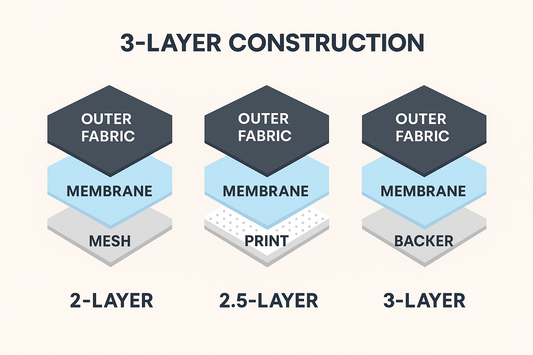
Membranes (2-layer vs. 3-layer)
A 2-layer membrane is usually enough for commuting, travel, and everyday winter wear—offering wind protection and basic waterproofing without feeling stiff.
A 3-layer membrane makes more sense if you spend long periods outside in wind-driven snow or mixed conditions. It's more durable and stable, especially when weather protection matters more than softness.
Insulation 101
Down: Down warmth depends on both fill power (how efficiently it traps air) and fill weight (how much insulation is actually used). High fill power alone doesn't guarantee warmth if the jacket doesn't contain enough of it. Down excels at warmth-to-weight, but performance drops once it gets wet.
Synthetic: Synthetic insulation is bulkier for the same warmth, but it performs more reliably in damp conditions. It's often more forgiving for wet, slushy winters.
Hybrid insulation: Many modern jackets mix insulation types to balance warmth and moisture control—using lofted insulation where warmth is needed and more moisture-stable materials where dampness builds up.
In addition to traditional fills, some jackets now incorporate advanced insulation materials:
- ET bio-down alternatives aim to mimic down's loft and warmth while offering better stability in humid or damp conditions.
- Aerogel-based insulation is used as a thermal barrier to reduce heat loss without adding bulk, rather than as traditional fill.
- Graphene-infused layers help manage heat more evenly, reflecting body warmth and improving comfort over long wear, with added benefits like odor resistance and reduced static.
- Sorona insulation is a bio-based option known for being lightweight, breathable, and resilient, helping insulation retain its shape and warmth over time.
Fit & Length
Shorter jackets offer better mobility and are easier to layer. Longer jackets provide more consistent warmth by covering the hips and upper legs, especially in wind.
A two-way zipper makes longer jackets far more practical, allowing easier movement, sitting, and temperature adjustment.
Climate & Lifestyle
City commuting: Walking and public transit favor wind protection and comfort; driving favors easier on/off and shorter length.
Travel: Packability and versatility matter more than maximum warmth.
Outdoor weekends: Weather protection and layering compatibility become more important.
Style priority: Minimalist, classic parka, or technical—choose what fits how you actually dress and live in winter.
Winter Jackets Care Tips
Help down (and down-alternatives) bounce back
If your jacket starts feeling "flat," it's usually not ruined—it's just compressed. After a wet day or a wash, dry it fully on low heat and toss in a couple dryer balls (or clean tennis balls) to break up clumps and restore loft. Stop the cycle occasionally, shake the jacket out, and feel for cold spots—if it's still cool or heavy, it's not dry yet.
Wash shells the right way + keep DWR working
Most "my jacket isn't waterproof anymore" complaints are really DWR wear-out or a dirty face fabric causing faster wet-out.
- Wash less often, but not never. Oils, grime, and sunscreen make shells wet out faster.
- Use a technical cleaner (avoid regular detergent and fabric softener), zip everything up, and rinse well.
- After washing, low heat in the dryer can help "reset" DWR on many jackets. If water still doesn't bead, it's time for a spray-on or wash-in DWR refresh.
Don't store it compressed (especially lightweight pieces)
Stuffing a jacket into a tight sack is fine for travel—for a few days. The problem is long-term compression. Lightweight puffers and lofty parkas can lose warmth over time if they live crushed in a closet bin or car trunk.
At home, hang it or store it loosely in a breathable bag.
If you must pack it, give it time to re-loft before wearing it in real cold.
A quick note if you're investing in a "one jacket" solution
If you're buying something you'll wear daily for years, prioritize the unsexy stuff: zipper quality, seam finishing, cuff durability, and how the hood seals. That's what separates "nice for one season" from "still great five winters later."
Conclusion
Ultimately, a good winter coat should silently solve various problems—such as insufficient warmth, damp fabric, and restricted movement—without drawing attention to itself. If you want to understand what a winter coat designed with advanced materials and everyday practicality in mind looks like, then take a closer look at how Alpargali creates practical and affordable winter coats.
Winter Jacket Shopping FAQ
There's no single warmest brand. Canada Goose, Fjällräven, Patagonia, and The North Face all make very warm parkas, while Alpargali stands out for using aerogel and graphene to boost warmth without heavy bulk. The jacket itself matters more than the logo.
The North Face: broad, reliable range for most winters
Columbia: strong value, especially on sale
Alpargali: performance-focused designs using advanced materials
The best choice depends on your climate and how you use the jacket.
A mid-thigh or longer insulated parka is usually the warmest. Jackets that combine traditional insulation with aerogel or graphene-enhanced systems can feel especially warm without adding much weight.
Only if you deal with wet snow, slush, or rain. In dry cold, wind protection matters more.
You can, but a ski-specific jacket is better for active skiing. Parkas work best for standing or casual resort wear.